
The Physical Characterisation Question Made Simple
Why Didn’t I Think of This Sooner?

To be honest, I can’t believe it’s taken me so long to discover this very useful way of answering the Physical Characterisation question in the Acting Grade 4 and Grade 5 Knowledge Discussion.
The Big Leap at Grade 4
The Knowledge at Grades 1-3 is pretty accessible, focusing on location, appearance, feelings and what is happening in the scene.
Then there is a big jump up to Grade 4, when they are asked to “explain how your physical characterisation helped to reflect the character, their feelings, moods and thoughts”. They are asked the same question again at Grade 5.
A student in a class this week said that he didn’t understand the question. I gave my standard response, and we had a discussion along these lines:
Me: You are playing a nursery school teacher in this scene. Imagine that it is a nursery school for trolls and you are a troll teacher. How would you move differently?
Him: I’d stomp about using heavy footsteps and maybe swing my arms a bit?
Me: Great! You’ve just described your troll character’s physical characterisation. I’ve used an extreme example of a troll to highlight what is meant by “phsyical characterisation”… But you’re not playing a troll, so it’s a bit less obvious. Before we think about your character, let’s start with you in real life. What species are you?
Him: Ummmm… Human?
Me: Okay and what gender?
Him: Male.
Me: And your age?
Him: 12
Me: And what time period do you live in?
Him: I mean… now?
Me: Okay so you’re a 12-year-old human boy living in the present day. Now, I’m not suggesting that all 12-year-old males in 2026 have exactly the same physicality… but you’ll have some things in common that distinguish you from 12-year-old females, or 57-year-old males, or 12-year-old boys from 1853. So who you are in terms of age, species, gender, time period will give us some information about your physicality. But your physicality right now in this room talking to me is different from what it would be listening to music in your bedroom, or sitting outside the headmaster’s office because you’re in trouble. So situation (which affects feelings, moods and thoughts) also needs to be taken into consideration.
Him: Gosh, Gabi, you are such an insightful teacher. I could listen to you all day, and now I completely understand physical characterisation.
At least that’s broadly how the conversation went. And I’ve had a similar conversation hundreds of times over the last however many years, ever since that question appeared on the syllabus. And then, of course, we go on to look at the character they are playing.
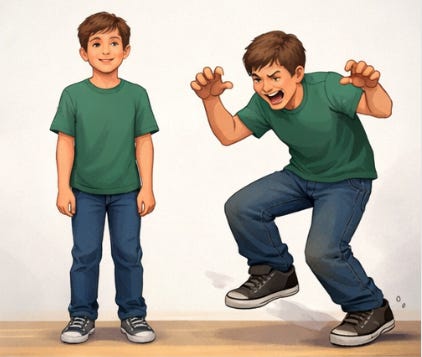
Starting with “Who Are You?” and “What’s the Situation?”
WHO ARE YOU: a 50 year old female bear in the present day
SITUATION: I’m on a cruise ship telling my new friends about the time I blackmailed a young girl’s family into paying for my holiday.
WHO ARE YOU: a 23 year old nursery teacher in the 1950s
SITUATION: I’m trying to teach a dance class but the children are playing up and I’m feeling frustrated
And then we think about how these things will affect physical characterisation during the scene and we write down our ideas in bullet points, ready to practise sharing out loud with the examiner during the Knowledge Discussion. Just like the example I shared in this article I wrote as one of my very first Substack posts more than two years ago.
The Revelation
So, what is the revelation I had this week?
I mean, honestly, I feel completely daft for not having ever done this before now. I am fully expecting the comments to be full of people saying, “well yes, obviously, I do that.” But just in case it’s helpful, I will share:
Keep reading with a 7-day free trial
Subscribe to Gabi’s Speech and Drama Community to keep reading this post and get 7 days of free access to the full post archives.